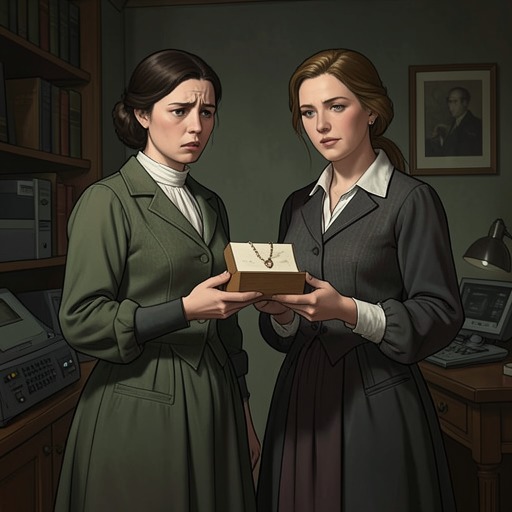
Charlotte Blacklock—Letitia Blacklock
A Murder Is AnnouncedCharlotte Blacklock and Letitia Blacklock are sisters whose lives are bound first by duty and care, then by an impersonation that turns their resemblance into a means of inheritance. Letitia’s decision to abandon her career for Charlotte establishes the moral contrast at the heart of their relationship: Letitia acts from a firm sense of responsibility, while Charlotte ultimately treats the fortune intended for her sister as if it were her own.
Sisters and Unequal Lives
The sisters grew up under a tyrannical father, an old country doctor described as narrow-minded and pig-headed. Letitia broke away to London and trained as a chartered accountant. Charlotte, by contrast, was an invalid with a physical deformity; she lived as a recluse and rarely went out or saw people. Their circumstances made the sisters’ adult lives sharply unequal, but did not dissolve their connection.
Letitia’s work brought her into the orbit of Randall Goedler, whose judgment she helped steady. She rescued him with money on at least one occasion, but her help went further: she kept him from crossing the line between what he considered clever business and what was dishonest. Her integrity was so central to how others understood her that Belle Goedler later described her as genuinely good. The trust between the sisters likewise shaped Letitia’s private life: she wrote Charlotte long accounts of events, trying to keep her isolated sister connected to the world beyond her own illness.
Care, Surgery, and Separation
When their father died, Letitia gave up her position with Randall to care for Charlotte. She took her sister to Switzerland to consult specialists about an operation. The procedure had been delayed, but it succeeded: Charlotte’s deformity was removed, leaving a scar that could be hidden beneath a choker of pearls or beads. The physical change offered the possibility of a different life, though Charlotte’s dependence on Letitia remained an important part of their shared history.
The Second World War broke out while the sisters were in Switzerland, making a return to England difficult. They stayed there and undertook Red Cross and other work. During this period, Letitia’s letters helped preserve a link between Charlotte and the life she had been unable to share directly. The sisters’ stay abroad was therefore both a continuation of their companionship and a separation from the English world in which Letitia’s future inheritance had been arranged.
Death and the Inheritance
Letitia, the healthy sister, contracted influenza that developed into pneumonia, and died within a week. Her death came just as Belle Goedler was believed to have little time left. Under Randall Goedler’s will, Letitia stood to receive his fortune after Belle’s lifetime. If Letitia died before Belle, the money was to pass instead to the legal offspring of Randall’s sister Sonia.
That alternative succession had been inserted at Belle’s urging. When Randall first said there was no one else to inherit if Letitia predeceased her, Belle reminded him of Sonia and proposed that Sonia’s children, Pip and Emma, should take instead. Randall objected to allowing Sonia’s husband, Dmitri Stamfordis, whom he regarded as a crook, access to the money, but eventually accepted the provision for her children. By the time of the later investigation, Letitia herself had not fully considered who would inherit if she died first; she supposed the money would go to Pip and Emma. The sequence of deaths thus made the sisters’ identities and the legal terms of the will decisive.
The Identity Exchange
After Letitia’s death, Charlotte took her sister’s place. The impersonation depended on how little most people had known Charlotte and on the resemblance between two elderly, well-bred Englishwomen who dressed much alike. Charlotte was buried under her own name, while the surviving sister returned to England as Letitia. The deception converted a real bereavement into a false public identity and positioned Charlotte to claim the fortune that would otherwise have gone to Sonia’s children if Letitia had died before Belle.
Charlotte’s reasons, as Jane Marple reconstructs them, combine resentment, identification, and financial expectation. Charlotte had imagined a future that Letitia’s death abruptly cancelled. She may have felt that Letitia had died at precisely the wrong moment, when Belle’s own death seemed near and the inheritance nearly within reach. Charlotte appears to have treated herself and Letitia as one, and so not to have regarded taking the money as truly wrong. That reasoning stands against the standard set by Letitia, who would not have contemplated fraud, however tempting the circumstances.
The impersonation required practical precautions. Charlotte bought a house in a part of England unknown to her, avoiding people from her Cumberland home town who might recognize her. Belle, who had known Letitia well, was also a danger, so Charlotte had to avoid any encounter that could expose the substitution. The arthritis in her hands helped account for differences in handwriting. Letitia’s letters supplied Charlotte with detailed knowledge of her sister’s London life, acquaintances, and experiences, enabling her to answer questions or refer to shared connections. Recognition as Charlotte—not as Letitia—was the central risk.
Meaning and Consequences
The sisters’ resemblance makes the identity exchange possible, but the story distinguishes them morally. Letitia’s outward strength is matched by a dependable sense of duty: she leaves her career, cares for Charlotte, and remains honest in her dealings with Randall. Charlotte, long confined to the role of the dependent sister, assumes the authority associated with Letitia after her death. Her new command of the inherited identity conceals not only who she is, but how far her moral outlook differs from the sister she imitates.
Their relationship is therefore transformed from a bond of care into the means by which Charlotte secures a fortune and conceals her own survival. The will’s alternate beneficiaries make the deception more than a private act of grief: the change of identity alters who can claim Randall’s estate. Once the substitution is exposed, the sisters’ shared past clarifies the fraud’s emotional logic without excusing it. Letitia’s loyalty had been real; Charlotte’s claim that their interests were one turned that loyalty into a justification for taking the life, name, and inheritance of the sister who had devoted herself to her.